Compute blade
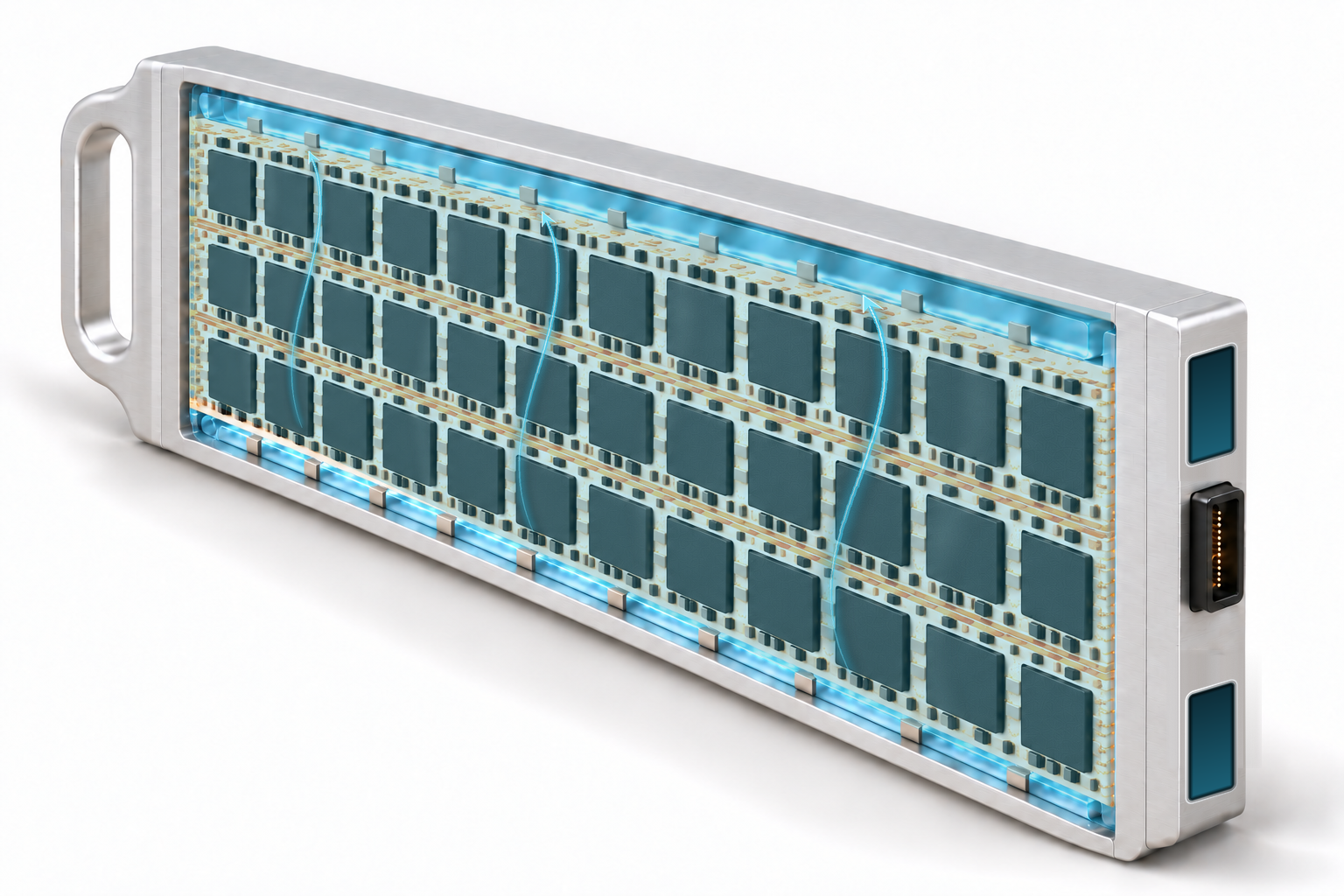
ASICs, a vertical circuit-bearing partition, fluid regions on both faces and a sealed module enclosure. A smoothly contoured handle forms part of the front case, supporting insertion and removal.
Crypto compute blade
A proposed ColdBoard application for dense ASIC arrays, with a vertical circuit board inside a sealed, replaceable module and reusable surrounding infrastructure.
INSIDE THE BLADE
The double-sided circuit board stands vertically within the blade, supporting and connecting the ASICs while separating the fluid regions on its two faces. Dielectric coolant wets the electronics; thermal-core regions can also contribute to heat spreading and transfer.
Flow distribution must serve the full active area. The inlet manifold, collection path, perimeter seals and board geometry must be evaluated together, rather than inferred from the rendered image.
A MODULAR SYSTEM
ASICs, a vertical circuit-bearing partition, fluid regions on both faces and a sealed module enclosure. A smoothly contoured handle forms part of the front case, supporting insertion and removal.
Low-profile rounded-rectangle fluid ports sit near the top and bottom edges, with their long axes aligned along the height of the narrow rear end face, with power/I/O between them. All connections face along the blade insertion axis. Rack guides support alignment; blind-mate connections are a design objective.
Pumps, heat exchangers, filtration and serviceable plumbing outside the compute blade.
WHAT MUST BE PROVEN
A replaceable blade needs defined isolation, drainage or dry-disconnect behavior, safe electrical disconnection and leak checking. Swappability does not by itself establish live hot-swap operation.
Platform reuse depends on compatible electrical, hydraulic, mechanical and control interfaces across generations. Flow uniformity, pressure loss, temperatures and long-term reliability require analysis and testing.
Define an evaluation programEVALUATION & LICENSING
Bring your ASIC package, power-delivery and service requirements.